


This is part of a multiple article series detailing the decree.
Today’s world is confronted with a multitude of environmental problems, some minor, requiring targeted solutions, while others are deemed as significant, needing multiple stakeholders to manage and resolve them.
Problems like a factory willfully violating environmental laws to save money can be resolved with a business closure order, while a country’s transition into renewable energy sources involves a multi-sectoral approach.

According to the World Bank, as the world continues to recover from the pandemic’s effects, global GDP per capita has returned—although barely—to its pre-pandemic levels. A significant portion of this growth comes from Asian countries like Vietnam, Indonesia, China, and India. Forbes reports that the region might account for more than half of the world’s middle-class by 2030.
The return of economic activity in many areas also meant the restoration of environmental pollution. Global CO2 emissions already rebounded to their highest-ever level in 2021, with coal as the primary contributor despite the significant growth of renewable power generation.
Given significant environmental pollution worldwide, it is no wonder life-sustaining ecosystems are under threat. In a 2020 report, the United Nations states that the global community has failed to fully achieve biodiversity targets it set back in 2010 during a conference in Nagoya, Japan. This failure has implications for a county’s future economic growth prospects.

Vietnam’s water situation
Water is one of the most significant inputs to production for a wide range of economic sectors. Firms engaged in mining, manufacturing, and distribution rely on water to extract, produce, and move goods toward their desired markets. The resource, therefore, is essential for a country’s long-term prosperity.
The International Water Resources Association considers Vietnam as part of its group of countries dealing with water shortage. This view is shared by the government, as one minister cites that around 63% of Vietnam’s total river flow comes from the nearby countries of China, Cambodia, Laos, and Thailand.
There is also the problem of pollution. A government report mentions that the country treats around 13% of its wastewater. Water pollution—according to data from the market research agency Indochina Research—is one of the top five concerns of the Vietnamese.
Vietnam’s air quality
The country additionally has to deal with air problems. Air quality is the number one concern of the population, according to a report in 2021. Indeed, there are links between air pollution and economic losses, with more than $10 billion lost (around 5% of the country’s GDP) per year due to a combination of health treatment expenses, work productivity impacts, and increased reputational risks.
Vietnam’s soil contamination issue
Agriculture accounts for around 15% of the country’s GDP and employs more than a third of its labor force, a report from the OECD mentions. It also shows that agricultural production has tripled since 1990.
However, this growth has consequences: the amount of fertilizer utilized by farmers has expanded by more than four times in the last two decades, according to a report from government authorities. There are also mentions of wasteful practices in fertilizer use. This increase in pesticide use has led to the problem of leakage in pesticide storage facilities, which leads to soil contamination.
Vietnam is no stranger to the presence of harmful materials on its land. The United States sprayed over 20 million gallons of herbicides to win the Vietnam War. These chemicals include Agent Orange, a dioxin-contaminated chemical that adversely affects humans, animals, and plants.
The country, however, is finding new chemicals in its soil as it grows its economy; Lindane and Aldrin, as well as other contaminants from industrial and construction work, have been found in urban areas.
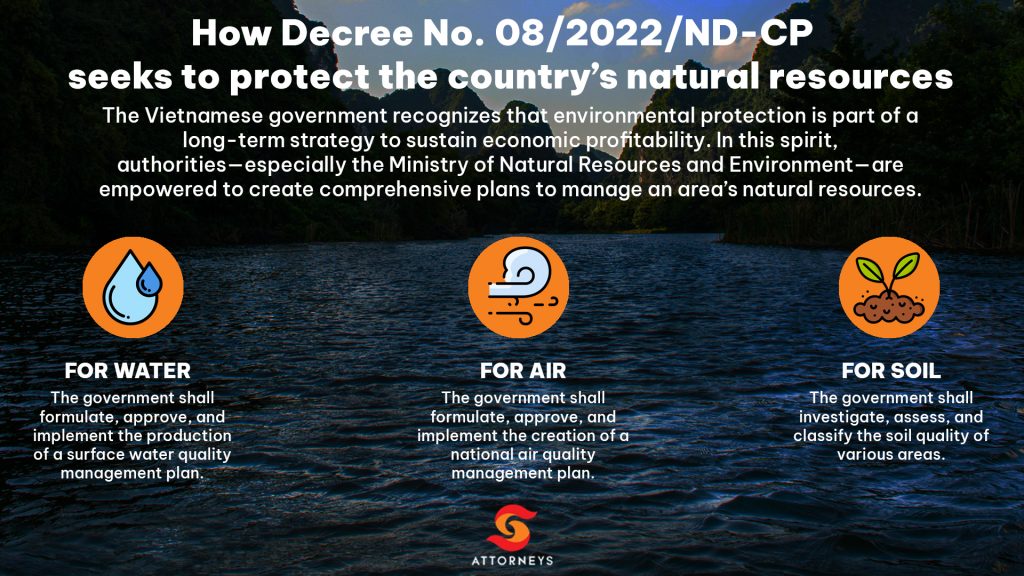
How Decree No. 08/2022/ND-CP seeks to protect the country’s natural resources
The Vietnamese government recognizes that environmental protection is part of a long-term strategy to sustain economic profitability. In this spirit, authorities—especially the Ministry of Natural Resources and Environment—are empowered to create comprehensive plans to manage an area’s natural resources.
- For water resources, the government shall formulate, approve, and implement the production of a surface water quality management plan that includes information detailing wastewater discharge quota for particular areas, prediction of pollution levels, and solutions to protect locations deemed as aquatic areas.
- For air quality, the government shall formulate, approve, and implement the creation of a national air quality management plan, that consists of data like air quality changes for the last three years and a spatial map that details the sources of air pollution.
- Another thing the government is empowered to accomplish is enacting emergency measures during cases of severe air pollution. These measures include actions like:
- Restrict, suspend, or adjust working hours of factories or other establishments found to have high emission discharge rates.
- Divert road vehicles.
- Adjust or suspend working hours of municipal agencies and schools.
- For soil resources, the government shall investigate, assess, and classify the soil quality of various areas, which include:
- Zones contaminated by Agent Orange and other harmful chemicals during the Vietnam War.
- Locations that once hosted manufacturing establishments engaged in the mining, processing, or production of cast iron and steel products, inorganic fertilizers, refined oil goods, agrochemicals, and batteries.
- For areas that are contaminated with agrochemicals.
Other highlights include:
- Natural heritage sites are ranked in three categories based on factors like size and environmental impact: provincial, national, and special. Special sites are recognized by multiple organizations or international treaties, such as the ASEAN Secretariat, Ramsar Convention, and the United Nations Educational, Scientific, and Cultural Organization (UNESCO).
- The Decree mentions the role of People’s Committees in managing heritage sites and states their various responsibilities, which include raising awareness and handling tourists. Businesses operating near the heritage site must practice low or zero-emission practices.
Why is this important?
Vietnam aims to escape the middle-income trap, a situation where a country can no longer compete in low-value and labor-intensive industries as wages increase but cannot participate in high-value and knowledge-driven industries because of limited support for an innovation ecosystem.
With an ambitious goal of net-zero emissions by 2050 and a country vulnerable to the impacts of climate change, the Vietnamese government understands the need to balance economic growth with environmental protection. The Decree shows the importance of water, air, and soil quality to the country’s long-term economic growth objectives.

